ch:3 They Told Him Never Dogfight a Zero – He Did It Anyway
He had only six or seven hours in the Corsair when he took it into the night.
The Japanese, operating from submarines, were launching seaplanes for reconnaissance—night flights over the naval harbor at Espiritu Santo. Those planes weren’t glamorous fighters. They were slow, dark silhouettes designed to see without being seen. The idea of meeting one at night was as much about nerves as skill.
They asked for a volunteer to go up and try to shoot it down.
Hank volunteered.
He was young. Enthused. The kind of young man who still believed bravery felt like an emotion rather than a decision. He took off into darkness so thick it seemed to swallow the airplane. Ground radar tried to vector him toward the intruder, voices in his headset guiding him like a lifeline. They’d get him under it, then he’d try to climb and find it against the stars.
He could see it sometimes—faint, moving, a shadow cutting across a field of constellations.
But he couldn’t slow down enough.
That was the irony: his fighter was too fast. The seaplane flew so slowly that Hank kept passing beneath it, overshooting, swinging wide, trying again. He never got a clean shot. But he came back with something more valuable than a kill: the feeling of his own airplane in the dark, the way the Corsair responded, and the knowledge that sometimes the enemy wasn’t dangerous because it was powerful—it was dangerous because it was hard to find, hard to reach, and hard to finish.
That first night mission in the Corsair was a thrill.
It was also a warning: excitement and danger are twins.
His first real air-to-air combat came soon after.
They were escorting dive bombers—SBDs—up toward Bougainville. There were about eighteen bombers, and sixteen Corsairs covering them. They were after shipping, but the weather had other plans: a big thunderstorm sat over the harbor, thick and towering. So the strike plan shifted—hit the airfield instead.
Hank remembered that moment vividly because it contained one of the most consistent truths of war: even when the plan changes, the enemy still gets a vote.
As the dive bombers pushed over into their attacks, Japanese fighters jumped them—twenty or thirty, by Hank’s estimate. Suddenly the sky exploded into motion. A dogfight doesn’t happen in one place; it spreads like fire. Planes scattered across a space he later described as maybe ten miles by ten miles—an entire patch of sky filled with machines trying to out-think, out-turn, and out-kill each other.
The Japanese got on Hank’s tail.
His flight leader, Captain Lundin, went after one enemy plane. Another enemy plane came after Hank. The formation broke. They got separated. That’s what happens when the sky turns chaotic—you lose the neat geometry, the comforting certainty that your wingman is exactly where he’s supposed to be. You begin to feel alone even when there are dozens of airplanes around.
Hank did the thing pilots often do when they need a breath: he went into a cloud.
Clouds are not cover in the way people imagine from the ground. They don’t make you safe. They make you blind. But sometimes blindness is preferable to being a clean target. He dove into the cloud to shake the enemy off his tail, and for a moment the world became white and roaring, moisture streaking the canopy, the horizon gone.
Then he came back out.
And there, directly in front of him, was a Zero.
So close it might as well have been parked there—about a hundred yards, he said, almost “just sitting there.” He didn’t hesitate. Training took over. He fired, six .50-caliber machine guns sending a dense line of bullets. In the Corsair, those guns were a brutal kind of certainty: you didn’t poke at a target; you poured fire into it.
The Zero exploded.
Hank didn’t have time to savor it. Another enemy was after him again. He dove back into the cloud. Out again. In again. A frantic rhythm of survival and attack, the kind where minutes become impossible to count.
He shot down two Zeros that day.
And then, as suddenly as the chaos arrived, it dissolved. He burst out of the cloud expecting another threat and saw… nothing. No airplanes. No friendly wings. No enemies. Just a wide, empty sky as if the dogfight had been a dream.
So he turned for home.
That was his first mission where it was truly air-to-air—where someone was shooting at him and he was shooting back. The day he stopped being a pilot who flew “combat tours” and became a combat pilot.
He loved the early Corsairs—especially the F4U-1 models before later modifications added extra armor and weight. Those early versions, he insisted, were unbelievably maneuverable. Powerful. Lightweight. They had problems—oil leaks, hydraulic leaks—but when they were right, they were magnificent. He said it like a man talking about a favorite horse: you could bank and turn and pull hard, climb fast, go fast.
He’d flown about 350 hours in Corsairs over time, and he said something that might sound like exaggeration unless you understand how deeply a pilot’s body memorizes a machine: he believed he could climb into a Corsair even decades later and fly it.
He also praised the mechanics.
Not with the casual gratitude people offer because it’s expected, but with genuine reverence. After missions, the ground crews worked all night to make planes ready for the morning. Exchange wings. Replace tails. Swap engines, carburetors, magnetos. Whatever it took. Hank said he never had a bad airplane—meaning not that the airplanes were perfect, but that the people maintaining them were extraordinary.
And yet, among all those aircraft, he had a favorite.
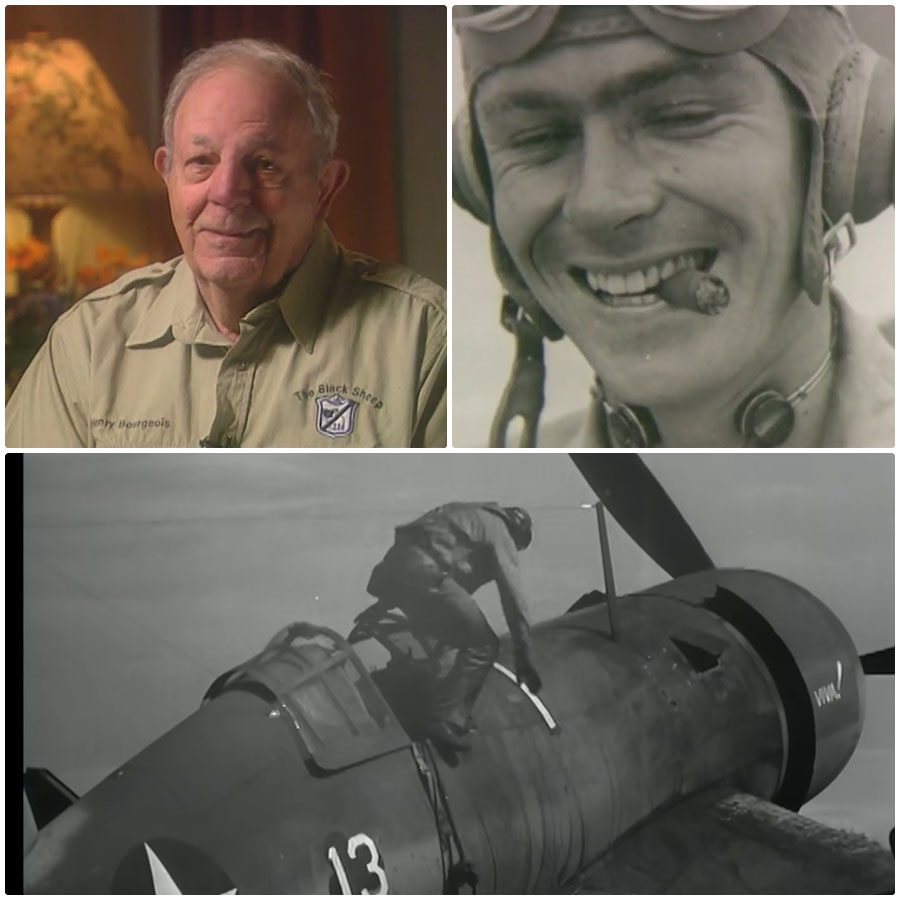
Corsair No. 13.
He seemed to fly it more often than the rest, not because it was assigned to him—no one had a personal airplane in his unit—but because it kept ending up in his hands. It had holes in it. It had been shot up. And still, Hank swore it always felt a little faster, a little smoother, a little better trimmed than the others.
He compared it to race cars: some machines just have something you can’t explain. Whether it’s slight differences in manufacturing, subtle maintenance quirks, or pure superstition, pilots often believe certain aircraft have “luck.” Hank wouldn’t call it luck exactly, but he felt the difference.
In his squadron, they usually had about eighteen airplanes assigned, and twenty-four or twenty-six pilots. Rarely did they have more than sixteen planes operational at a time. Some were always down for parts, repairs, or the kind of maintenance you don’t see until you’ve watched an exhausted mechanic wipe grease from his hands at dawn.
You flew what was available.
See more on the next page
Advertisement
