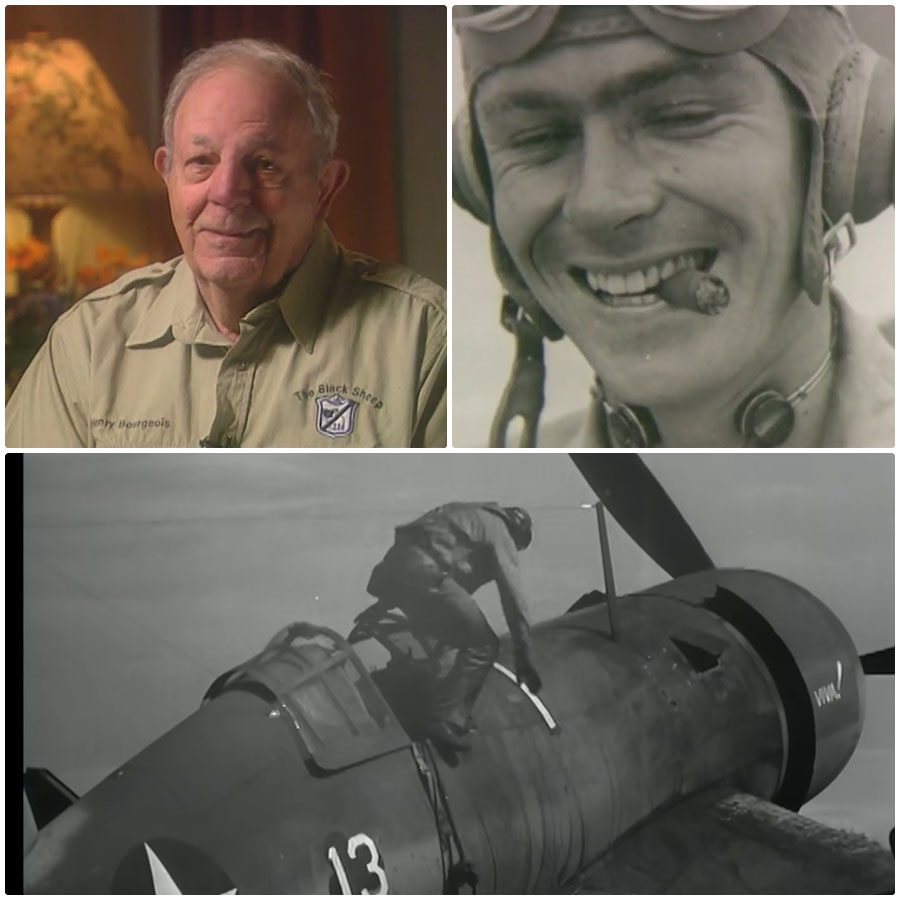
A man named Frank Walton would assign the planes: “You’re flying No. 22 today.” Or “Take No. 7.” You didn’t argue. You accepted it, checked it, trusted the mechanics, and went.
As Hank gained experience, he learned something else they’d been briefed on early: the Japanese Zero was a deadly aircraft in a turning fight. Fast, maneuverable. If you tried to out-turn it, you’d lose. The doctrine was simple: keep speed, use the Corsair’s power, and dive away if the Zero got on your tail.
But there was a vulnerability.
The Zero lacked certain protections—less armor, no self-sealing fuel tanks in many variants. If you could land a solid burst into it, it could go down fast.
One of the men—John Bull—became fascinated with armament. He worked on the sequence of rounds, ensuring a mix—incendiary, armor-piercing, tracer—so that the gunfire wasn’t just bullets, it was a carefully designed storm. He spent time with the ordnance crew making sure the guns were “zeroed” to converge at around 200 yards.
And Hank was emphatic about this: when you hit an airplane with six .50-caliber machine guns, it is enormous firepower. The guns fire so fast, the impact so violent, that you might knock a wing off, tear away a tail, or kill the pilot instantly. It wasn’t romantic. It was mechanical, fast, and final.
In those days, the language men used about the enemy was often harsh—war makes men speak in ways they might not otherwise. Hank admitted their attitude was simple: defeat the enemy. Kill or be killed. Yet even inside that brutal mindset, he acknowledged lines some men would not cross. He said he couldn’t bring himself to shoot someone in a parachute. He also knew some did. War, he learned, contains tragedies that aren’t always caused by the enemy.
Sometimes they’re mistakes.
He recalled escorts for B-24s where unexpected Corsairs joined the formation, and a pilot mistook them for enemy aircraft and fired. Fortunately, it caused only holes in the airframe. In another case, a pilot mistakenly attacked one of their own PT boats, and the PT boat fired back, shooting him down. Bad weather, confusion, and the sheer speed of decisions could turn a moment into a disaster.
Hank himself remembered a mission where his division was assigned to strafe a Japanese base that was supposedly deserted. On the way back in lousy weather, the last man saw what looked like an enemy barge moving through the water. He broke off and strafed it—only to realize it was friendly.
“You make mistakes,” Hank said, without trying to excuse it. Just naming it.
By then, Hank had flown two combat tours with VMF-122. In those days, three tours could qualify you to go home. But the war had a way of rerouting lives. When VMF-122 rotated home, Hank found himself in a pool of pilots.
Then came a name that still echoed through aviation history: Gregory “Pappy” Boyington.
Boyington was designated to command the newly formed VMF-214. He went through the pool and selected pilots with combat experience. Hank—who had two tours and confirmed kills—was one of those picked.
That’s how Hank became one of the Black Sheep.
The Black Sheep Squadron was already becoming legend even as it formed—an identity shaped by combat, personality, and the strange culture that grows among men who live close to death. When Hank first met Boyington, it was on a transport before Christmas 1943. There were parties. Boyington was introduced as “Greg.” Hank didn’t know who he was at the time. Only later did he realize the man was the senior officer in the replacement pool aboard the ship.
What Hank remembered most from those days wasn’t a lecture or an official speech.
It was bridge.
Boyington liked to play. Hank liked to play. The voyage to New Caledonia took seventeen or eighteen days, and they played a lot. In those hours, between shuffles and bids, Hank got to know Boyington as a man—charming, volatile, restless. Boyington had brought a case of Scotch intended as a gift for a general out there, Hank joked, but he suspected Boyington drank it himself on the way.
Hank liked him.
But liking someone and trusting their leadership are different things, and Hank’s impressions of Boyington in the field were complicated. On the ground, Boyington drank heavily. He was not, in Hank’s view, an administrator. The squadron’s daily functioning—paperwork, planning, the machinery of operations—often fell to others, particularly Frank Walton, who served as the intelligence officer and effectively ran the “ground” side of the unit.
Yet in the air…
In the air, Hank said, Boyington was something else entirely.
He remembered dawn patrols—two hours of circling with nothing to do but stare at clouds and water and hope the enemy appeared. That kind of boredom is dangerous; it tempts men into carelessness. To fight the monotony, pilots would start doing loops, rolls, wing-overs. And Boyington would do them with an aggressive, joyful confidence that left younger men sweating just trying to keep up.
Boyington had a will to win that bled into everything. Hank described watching him on the recreation deck during the voyage, when Marine Raiders practiced hand-to-hand fighting and boxing. Boyington threw himself into it regardless of rank—corporal, sergeant, another major—it didn’t matter. He wanted to win. To beat the opponent down. That same hunger appeared in the cockpit. In a dogfight, Boyington was brilliant and fierce.
In combat, men depend on each other. Friendships form quickly, intensely, because they aren’t based on years of shared history—they’re based on surviving the same terrifying minutes. Hank compared it to a football team: you work together, you want to do well, and a kind of comradeship grows from that.
In VMF-214, that comradeship felt even stronger.
Part of it, Hank believed, came from the rituals they developed after missions. They had singers—three or four men who could actually carry a tune. At night, after flying, the doctor might give them a couple of brandies, and they’d sit close together and sing. It sounds almost gentle until you remember where they were: a strip of land in the Pacific, surrounded by war. Those songs were not entertainment as much as they were survival—proof that they were still human.
The squadron’s identity also mattered. When they were organizing and knew they would be assigned to VMF-214, the men debated a name. Someone suggested “Boyington’s Bastards.” Walton, pragmatic, shut it down—newspapers back home wouldn’t print it. They argued, searched for something that fit, and finally landed on “Boyington’s Black Sheep”—a phrase that captured their rebel spirit without crossing the line into something unprintable.
An artist—Hank remembered he might have been a Marine correspondent—drew up their insignia: a shield with a “bastard stripe” and the rest of the design. It was accepted, and it stuck. It became part of their myth.
At the time, Hank didn’t realize how much Walton was feeding that myth. Walton sent press releases back to the United States—sometimes even to pilots’ hometown newspapers. Hank said he came home later and was treated like a hero without having known the press had been printing stories about him. Walton understood something important: morale is a weapon, too. Stories about victories mattered.
They certainly mattered for Boyington, whose early combat success—shooting down multiple enemy aircraft in a single day—made him catnip for correspondents. As the numbers rose, the attention increased. By the squadron’s second combat tour, journalists hounded them, hungry for a narrative that could travel across the Pacific and land in American living rooms as hope.
Hank found himself in the middle of one of those big melees—the kind of swirling fight where you fire at shapes and flashes and only later try to piece together what happened. He said one lesson came out of that day, burned into him with the intensity of experience.
After the fight broke up and the planes scattered, he was heading back to Munda when tracers flashed past his aircraft. He glanced in his mirror and saw it: a Zero behind him.
He was not going too fast at first. He shoved everything forward—full throttle, every ounce of power the engine could give. The Zero closed the distance anyway. Every so often, it fired cannon shells or bullets. Hank could feel the threat even when the rounds missed. The enemy was patient. Persistent. Hungry.
The standard move in a Corsair when a Zero was on your tail was to dive—use speed. The Corsair could out-dive and out-run the Zero if you did it right. Hank shoved the nose down and dove low, skimming toward the deck.
The Zero stayed with him.
Hank pushed for more speed, closing flaps—cooling flaps, oil flaps—anything that might squeeze a little more out of the airplane. Still the Zero crept closer. He realized something else: he wasn’t flying directly back toward base. He was angling away. His fuel was getting low.
That’s when his calculation changed. He decided he would have to fight.
See more on the next page
Advertisement
