And—without thinking—two small blankets, the kind that feel like comfort
The cashier stared at him like he was either a saint or a thief.
Gustavo just paid, loaded the bags, and drove into the night.
The streets were nearly empty at that hour, but Mexico City never truly sleeps. A few taxis glided by. A street vendor packed up under a dim light. Somewhere, a dog barked into the cold.
By the time he reached the neighborhood, the sky was starting to soften from black to deep purple. The city’s breath felt different here—less polished, more real.
His contact had given him an address range, not a pinpoint. Gustavo parked a few streets away and walked with the bags, scanning the old buildings with peeling paint and barred windows.
Finally, he found it: a small, worn door with a weak porch light above it.
He took a breath and knocked softly.
Inside, María Isabel was swaying with her baby in her arms, trying to quiet him with the last ounce of cheap formula she had left.
Her son—Santiago—was six months old, small for his age, with eyes too big for his little face. The kind of baby who looked like he was always on the edge of crying because his body didn’t feel safe enough to relax.
María had been up most of the night.
She was twenty-four, a cashier at a small store, and her life had become a constant math problem:
Rent for the tiny room.
Diapers.
Bus fare.
Food.
And now—special formula the doctor insisted on because Santiago needed more nutrition than the cheapest brand could provide.
The pediatrician had looked at her with genuine regret.
“Your baby needs this,” he’d said. “But I can’t give you free samples.”
María had nodded like she understood.
Then she’d gone home and cried in the bathroom so Santiago wouldn’t see.
She hated asking for help. It made her skin burn with shame. Her grandmother had raised her on one sacred rule:
“Poverty isn’t shame if you work honestly. But dignity is not for sale.”
So when María finally texted that number, it felt like jumping off a cliff.
She’d heard about a woman who “helped single mothers.” A coworker had scribbled the contact on a torn paper.
In her panic, María typed it wrong.
Now, when someone knocked at her door at dawn, her heart slammed into her ribs.
She wasn’t expecting anyone. The father of Santiago had vanished the moment he learned she was pregnant. She had no one who would show up.
The knocking came again, gentle.
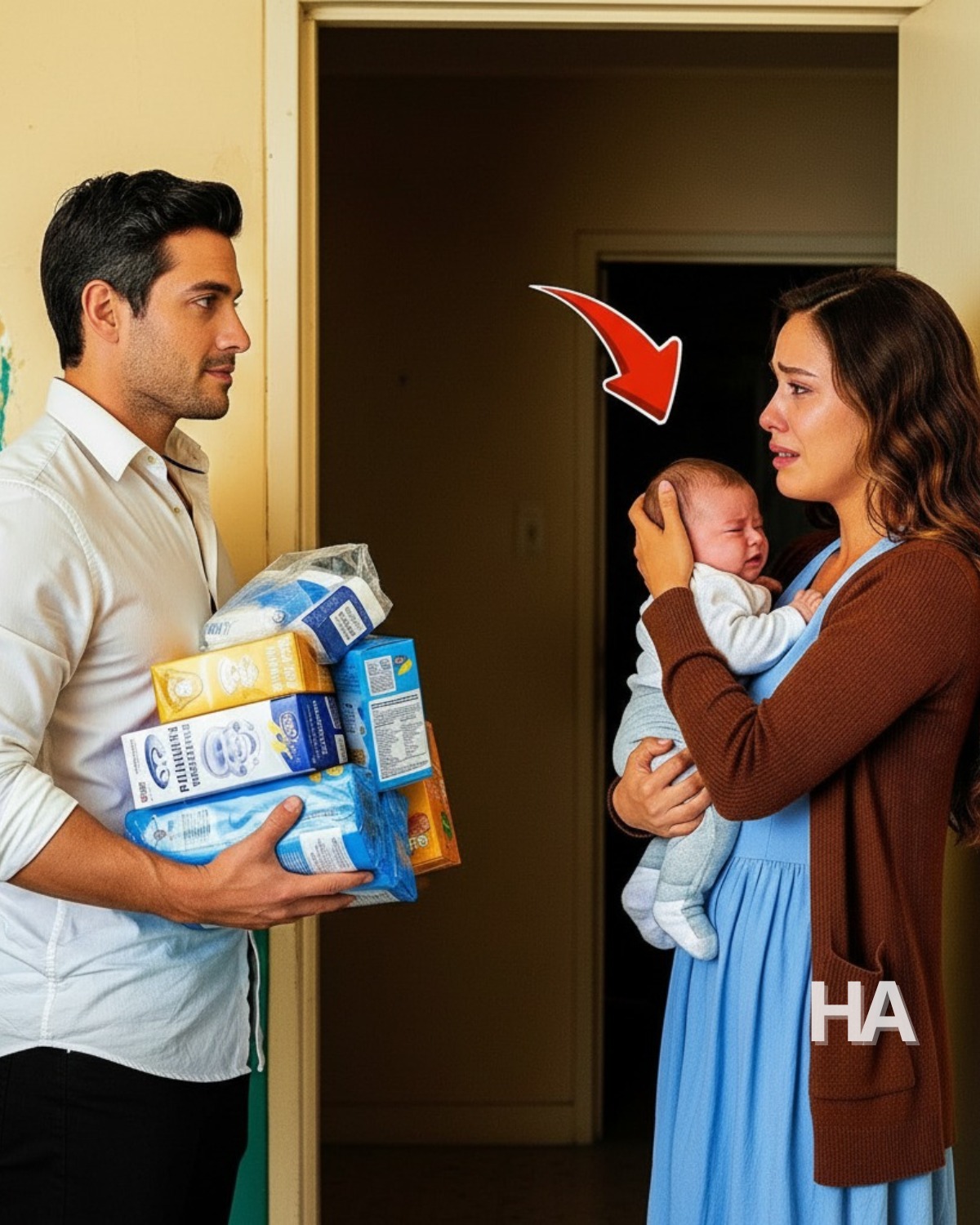
María tiptoed to the door with Santiago pressed against her chest. She didn’t open it fully—just a crack, chain still latched.
A man stood outside.
Tall. Simple white shirt, jeans. No fancy suit. No fancy smile.
He held several pharmacy bags like he’d come prepared for a storm.
“Good morning,” he said quietly, careful not to scare her. “Miss… I don’t want to frighten you. I got your message last night.”
María’s throat tightened.
“…My message?” she whispered.
“Yes.” He lifted the bags slightly. “And I came to help.”
Fear clashed with hope like lightning.
“How did you find my address?” María asked, voice shaking.
The man didn’t lie. “I have contacts who can locate a phone number. I know that sounds strange. If you want me to leave, I will. But… I couldn’t sit in my home knowing a baby was hungry.”
Santiago started crying harder, sensing his mother’s tension.
María’s instinct screamed close the door.
But Santiago’s cry—pure hunger, pure need—broke her pride clean in half.
Her shoulders slumped.
With trembling hands, she unhooked the chain and opened the door.
The man stepped inside and took in the tiny room without judgment.
The place was poor, but spotless. The walls were worn, but clean. A used crib, carefully made. Clothes folded with precision on a chair.
Not chaos.
Not neglect.
Just a woman doing everything she could with almost nothing.
He set the bags down gently and moved with calm purpose—like he’d done this before.
He opened a can of special formula. Found a bottle. Measured carefully.
María stared at him in disbelief, heart hammering, tears building behind her eyes.
“Why are you doing this?” she managed.
He didn’t hesitate.
“Because no one should watch their child cry from hunger,” he said, voice steady. “And because sometimes messages reach someone who can do something—by accident.”
He shook the bottle, checked the temperature like he wasn’t trying to impress anyone, just trying to help.
When Santiago finally latched onto the bottle, the crying stopped instantly.
The silence that followed wasn’t empty.
It was relief.
María’s knees almost gave out. She covered her mouth with her hand and let out a sound between a sob and a laugh.
The baby drank like his life depended on it.
Because it did.
María looked up, eyes wet.
She noticed details now—his watch wasn’t flashy, but it was expensive. His shirt fabric was too high quality for a “regular” guy. His calm was the calm of someone used to command.
“You’re…” she whispered, embarrassed, suspicious. “Who are you?”
He paused.
“My name is Gustavo,” he said simply. “Gustavo Herrera.”
The name meant nothing to her at that moment.
Not yet.
But she could feel it.
This man wasn’t just kind.
He was powerful.
And power usually came with strings.
As Santiago drank, María’s pride woke up again, wounded.
“I’ll pay you back,” she blurted. “Every peso. It might take time, but I will.”
Gustavo looked at her with something that wasn’t pity—it was respect.
“I don’t need repayment,” he said softly. “I’m not here because I think you’re taking advantage. I’m here because you’re a mother. That’s enough.”
María’s eyes narrowed, not in anger—more like fear trying to protect her.
“People don’t do things for free,” she said quietly.
Gustavo nodded. “You’re right. Most don’t.”
He glanced at Santiago, peaceful now, milk dribbling slightly at the corner of his mouth.
“I’m doing this because I can,” Gustavo said. “And because someone once did it for my mother. That hand saved me. I never forgot.”
María didn’t know what to say.
So she said the only honest thing:
“Thank you.”
Gustavo didn’t smile like a hero.
He just nodded, like gratitude wasn’t the point.
Before he left, he placed more formula cans on the table and a note with his number.
No title. No last name. No business card.
Just: Gustavo.
“If you need anything,” he said, “call.”
Then he kept his promise and left without demanding anything, without making her feel small.
But when the door closed behind him, María pressed her back against it, shaking.
Because nothing in her life had ever changed this fast.
And because she was terrified that it was temporary.
The next few days were a strange mix of relief and discomfort.
Every time María prepared a bottle from that special formula, her chest warmed with gratitude.
See more on the next page
Advertisement
