It was a plain email. No greeting, no warmth, just a few lines typed beneath Nenah’s signature, sent from her iPhone. The subject line read, “Holiday plans.”
I stared at the notification for a full minute before opening it, even though the sinking feeling in my gut told me I already knew what it contained. It wasn’t a call from my son. It wasn’t even a voice memo. It was just that flat, sterile screen glow, delivering a message that felt more like a calendar alert for a dentist appointment than a family invitation.
For a mother who had once wrapped Garrett’s birthday gifts in hand-painted paper and baked three different cakes because he couldn’t decide on a flavor, this moment landed harder than it should have. I wonder if any of you have ever read a message so short, yet felt something in your chest pull just a little bit tighter? That quiet tug. The kind that whispers you are no longer the protagonist of the story; you are barely a footnote.
The message read: “Christmas dinner will be at our house again this year around 5. Hope you can come.”
No signature. No love. No mention of my name, “Mom.” Just that one word: Hope. It sat there like it was optional. Like I was optional.
It hadn’t come from Garrett. It came from Nenah. That stung more than I admitted. My son and I used to talk every Sunday, without fail, even if it was just for ten minutes to recap the week. Now, I got monthly texts, and even those felt like receipts—proof of life, but devoid of living.
Still, I sat with it. I reread it until the pixels blurred. I stared out the window at the bare trees losing their fight against the December wind, their skeletal branches scratching against the gray sky. And even after all that, I replied.
“Thank you. I’ll be there.”
I typed it slowly, carefully, like the words might break if I pressed the keys too hard. I didn’t ask if they needed anything. I didn’t offer to bring food or help set up. I knew better by now. I’d been slowly taught where the line was—a border drawn in invisible ink—and this time I wasn’t going to trip over it trying to make things easier for them.
I closed the laptop and sat back in my chair. For a moment, I allowed myself the dangerous luxury of wondering what it would feel like if Garrett had called me himself. If he had said, “Mom, I really want you there. It’s not Christmas without you.”
But those kinds of thoughts don’t help. They only scratch at old scabs, making them bleed fresh. The clock ticked loud in the quiet house. I glanced toward the corner cabinet where a box of decorations still sat unopened. I hadn’t bothered yet. Maybe I would, maybe I wouldn’t. The invitation was cold, bordering on icy, but I was still going. Because sometimes, even when the door barely opens, we still walk through it, hoping something inside might be warmer than the way we were asked to come.
But as I sat there, a thought occurred to me—a small, dark seed of realization. If I was going to be treated like a stranger, perhaps it was time I stopped acting like a savior.
I started with the mulling spices, not because they were necessary—Nenah usually ordered catering—but because the smell reminded me of winters when Garrett was still small enough to curl up beside me on the couch with a book. Cinnamon and orange peel always brought him running to the kitchen, asking what was baking. Back then, I never minded the interruptions. I lived for them. These days, the kitchen stayed quiet even when I was cooking a feast.
I opened the pantry and pulled out the mason jars. I had saved the last of the summer blueberries, preserved them the way my mother taught me, boiling the fruit until it surrendered its sweetness. I added a hint of nutmeg and lemon zest and cooked the batch slow. One small jar would go in the gift bag, tied with red twine and a handwritten label.
The label was the important part. I had written: “From my kitchen, always with love.”
Next came the photo album. I had started collecting the pictures months ago, not for any particular reason, just something to do when the house felt too still and the silence pressed against my eardrums. Garrett’s first Christmas, his missing front teeth, the shepherd costume he wore for the second-grade nativity play. I arranged the pages carefully, alternating photos with small notes—not to impress anyone, but to preserve something only I seemed to remember.
I paused when I reached the photo of us at the lake. He was ten, wrapped in a oversized beach towel, laughing with chocolate ice cream on his face. I had taken that photo just after he fell off the paddleboard and swore he’d never try again. He had tried again the next morning.
That was who he used to be. Resilient. Sweet. Still unsure, but open.
I slipped the photo into the plastic sleeve, then slid the album into a cloth bag embroidered with a stitched snowflake. Beside it, I tucked the jar of preserves and the folded letter I had written on stationery Garrett gave me five Christmases ago. It was pale green with a gold border, the kind that made even simple words feel important.
I didn’t write much. Just enough to say that I hoped we would share more than space this year, that I missed the sound of him laughing without looking over his shoulder for approval, and that even now, I still believed in second chances.
The bag wasn’t big. It wouldn’t stand out under a glittering, designer-decorated tree. But it carried thirty years of winter mornings, scraped knees, late-night school projects, and quiet prayers whispered through closed doors.
I placed it by the front door, ready for the next morning. Even if I wasn’t sure how I’d be received, I wanted to arrive holding something that reminded me of who I was. Not just Garrett’s mother, but someone who remembered how to love, even when the love wasn’t returned. I went to sleep that night with a heaviness in my chest, a premonition that tomorrow would mark an ending, though I didn’t yet know what kind.
The sky had turned a soft, steely gray by the time I pulled into their neighborhood. It was an upscale area, the kind of place where the driveways were heated and the fences were high. Snow was already beginning to gather along the edges of the road, thin white veins stretching across the sidewalk.
I parked by the curb—not in the driveway, I knew better than to block Nenah’s SUV—and turned off the engine, letting the silence settle for a moment.
Their house looked warm from the outside. Light glowed in the windows, flickering across the front room like a fireplace might be going. I could hear laughter, faint but clear, rising above soft Christmas music. Someone was clinking glasses. A child’s voice squealed with delight. It all sounded lovely. It sounded like a home.
I gathered my gift bag from the passenger seat, checking one last time that the album was safe. My gloves were in my coat pocket, but I didn’t put them on. My hands were shaking, and I needed to feel the cold to ground myself.
The walk up the drive felt longer than I remembered. I passed the familiar row of hedges Garrett used to help trim in the summer—the ones I bought after they first moved in to add “curb appeal.” They looked the same, just dusted in white, now brittle and bare.
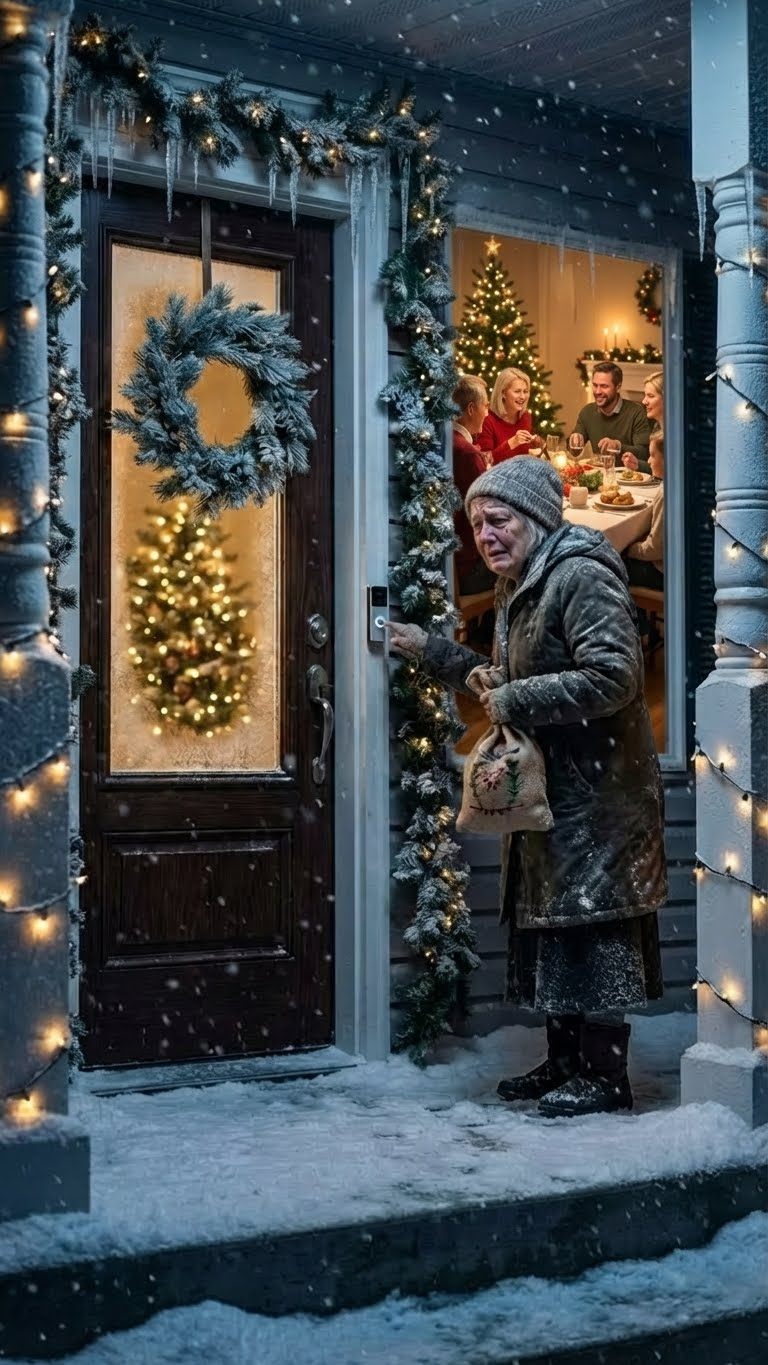
I climbed the steps slowly, careful on the patches of ice. The doorbell was new—sleek, digital, with a camera eye staring back at me. I pressed it once. A soft chime rang inside.
Then, nothing.
I waited. No footsteps, no shadow growing larger behind the frosted glass. Just more laughter in the background, a burst of conversation I couldn’t decipher.
I rang again. This time I leaned forward, listening closer. Still nothing.
I stepped back and glanced around. My boots were beginning to soak through. Snow caught in the cuffs of my pants, melting against my ankles. The paper bag in my hand started to soften and sag under the moisture of the falling snow.
I didn’t move. Ten minutes passed.
A car drove by slowly, tires crunching over fresh snow. The driver gave a quick nod and a wave, assuming I was a guest waiting for a host who was just a moment away. I nodded back, forcing a smile that felt like cracking plaster. There was no explaining what I was doing. No polite way to say I had been invited, but not expected.
I stood another five minutes. Then ten more.
The cold worked its way into my bones, deep and slow, like a grief that didn’t need words. The front porch light flickered once, then steadied. Still, no one came. I shifted the bag to my other hand. It had started to feel incredibly heavy, burdening my shoulder.
From behind the curtain, a movement. I couldn’t be sure, but something stirred inside. A shadow. A shape. Someone looked out, saw me standing there in the snow, and let the curtain fall back.
They knew I was there.
I rang the bell one last time. Not in anger. Not even in hope. Just in quiet finality. Then I stepped back down to the sidewalk and waited. I told myself I would wait five more minutes. Just five. After all, I had said I would come. And I had, even if no one was opening the door.
My heart hammered against my ribs, a frantic bird trapped in a cage. Was this it? Was I to be left out here until I simply froze and blew away?
The door finally opened.
Garrett stood there. He wore a cashmere sweater I didn’t recognize. His expression was neither welcoming nor annoyed. It was blank. Like he had stepped into a room and forgotten why he was there.
He blinked twice, then said my name. “Mom.” It sounded more like a reminder to himself than a greeting.
I nodded and lifted the soggy gift bag. He didn’t reach for it. He just stepped aside.
See more on the next page
Advertisement
