Christmas dinner at my dad’s house always followed a script.
Coats tossed on the bed in the guest room. Shoes lined up by the door like soldiers. My sister Beth’s kids sprinting laps through the hallway while the adults pretended their temples weren’t throbbing from the noise.
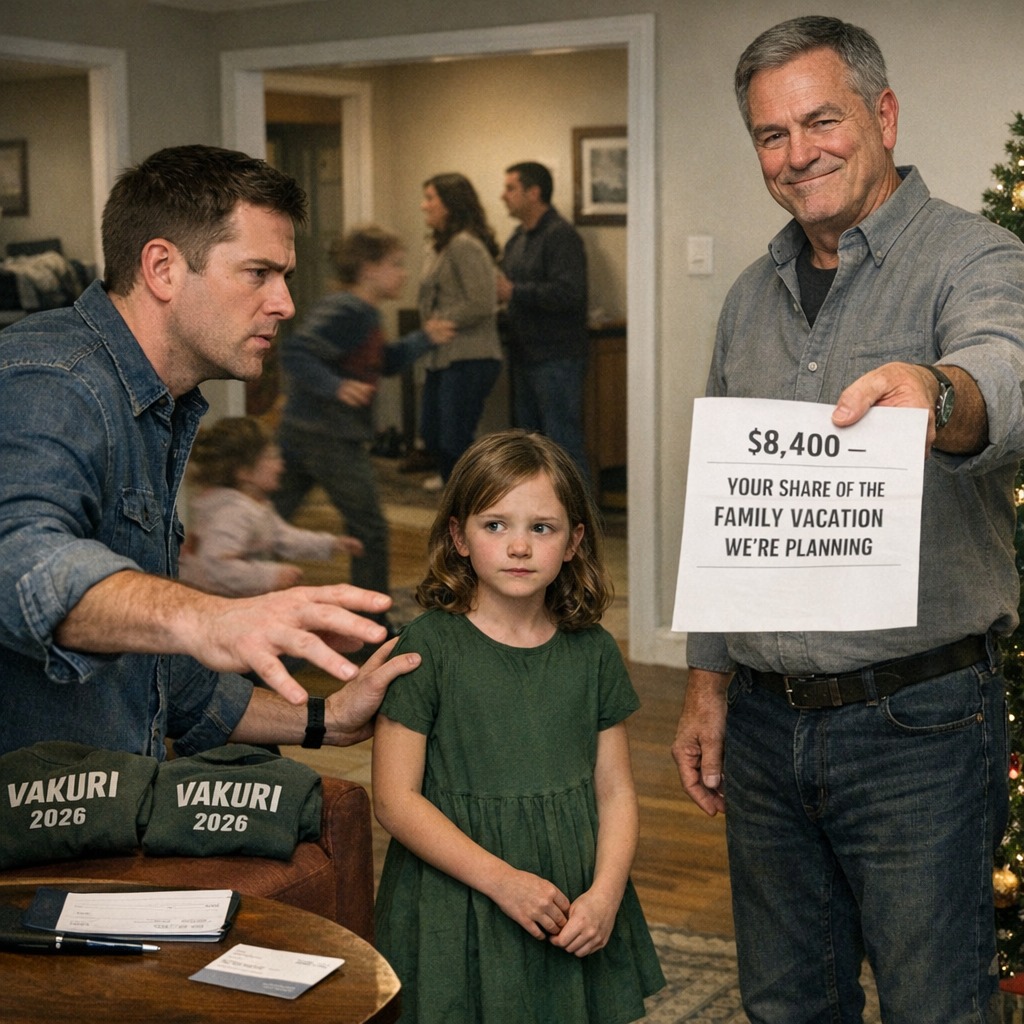
I should’ve known something was off the second I walked in and saw the sweatshirts.
Three of them—matching, folded neatly on the back of the couch like they were part of the décor.
VAKURI 2026 in block letters.
All in kids’ sizes.
None in my daughter’s size.
Nora stood by the tree with her hands tucked behind her back, rocking on her heels like she did when she was trying to be brave. She was nine. Quiet. Polite. The kind of kid who said “excuse me” to the dog when she squeezed past him in the hallway.
She’d worn the green dress she picked out herself, the one with the soft skirt and the little gold buttons at the collar. She’d even curled the ends of her hair in the bathroom mirror at home, because she wanted to look like a real grandkid.
That thought still makes my throat tighten.
I pretended I didn’t notice the sweatshirts. Nora pretended harder.
Beth swept in with her usual energy—loud laugh, quick hug, moving like the house belonged to her more than it did. Her husband, Mark, followed behind her with that weary look dads get when they’ve been outnumbered since breakfast.
Tanner, her oldest, was already halfway up the stairs despite being told three times not to run. Kenzie was bouncing on the couch like it was a trampoline. Milo was smearing something sticky on a toy car and laughing like it was the funniest thing on earth.
Dad—my dad—stood in the kitchen pouring himself a drink like Christmas was a job and he needed to get through it.
“Larry,” he said, like my name was an item on a checklist.
He clapped my shoulder once, firm, like he was approving a contractor’s work, then looked past me.
“And… Nora,” he added, after a beat.
He didn’t hug her. Didn’t kneel down. Didn’t ask about school.
He nodded at her the way you nod at a neighbor’s kid you don’t know well.
Nora smiled anyway.
She always smiled anyway.
I used to call her resilient.
Now I knew the truth.
Resilience is what kids learn when nobody else changes.
Dinner happened the way it always did.
Beth “accidentally” forgot the salad she promised. Dad poured a second drink before the pie was even cut. My aunt Diane wasn’t there this year—she was “doing her own thing,” which is what she said every time she refused to walk into my father’s orbit.
Conversation drifted across safe topics: the weather, Beth’s coworker who was “so annoying,” Tanner’s soccer, Kenzie’s obsession with slime, Milo’s new phase of not wanting to wear shoes.
Nora ate quietly, elbows tucked in, face careful. She tried to laugh at the right moments. She offered to clear plates without being asked. She asked Beth, politely, how her day had been, the way she’d learned to do with adults, because she’d learned that adults liked being asked about themselves.
Beth responded with a distracted “Mm-hm,” like Nora was a polite cashier.
I caught Dad glancing at Nora twice—quick looks, not soft ones. The kind of look you give something you’re deciding whether to include in a photo.
After dinner, Dad did what he loved most.
He made an announcement.
He stood in the living room like he was about to hand out medals.
Beth’s kids lined up without being told. They knew the routine. Dad liked to give gifts in a certain order, like it proved something.
He held up three white envelopes.
Not Christmas envelopes with glittery reindeer.
Airport envelopes. The kind with bold print and a little airline logo in the corner.
Beth’s oldest, Tanner, got one.
He ripped it open and screamed because it was a printed itinerary. Plane tickets. His name in big letters. A resort. A theme park. Dates.
“NO WAY!” Tanner yelled, jumping like he’d been electrocuted with joy.
Beth clapped her hands and laughed, watching her kid like he was the main character.
Kenzie got one next. Same squeal, same jumping, same “OH MY GOD.”
Milo got one and immediately started flapping it around like a bird while Mark tried to grab it before it tore.
Everyone laughed.
Dad smiled like he’d invented joy itself.
Then he looked at Nora.
He didn’t hand her an envelope.
He didn’t say her name.
He just nodded at her like she was an extra in the scene.
Nora’s smile stayed on her face for one second too long, then slid off—just a little—like it had lost grip.
She glanced down and fiddled with the ribbon on her dress.
I waited.
I waited for Dad to say, “And Nora—”
He didn’t.
Instead, he cleared his throat and slid a fourth envelope across the coffee table toward me.
This one was thicker.
Heavier.
“I figure it’s best to be upfront,” he said, loud enough for everyone to hear.
I opened it.
Inside was a single sheet of typed paper.
Neat. Clean. Clinical.
Like a dentist bill.
$8,400 — YOUR SHARE
Under it, in smaller print, was a breakdown:
Flights. Resort. Rental car. Park tickets. Emergency fund. Souvenirs.
And at the bottom, bolded like a final punchline:
Your responsibility: $8,400.
I stared at it so long the numbers started to blur.
Then I looked up.
“What is this?” I asked.
Dad’s eyes flicked to Nora for half a second, then back to me.
“A family vacation,” he said like I was slow. “We’re planning it.”
My mouth went dry. I swallowed.
“I wasn’t invited.”
Beth made a little sound in her throat—a warning sound—like I was about to embarrass her.
Dad didn’t blink.
He smiled.
Not warm. Not awkward.
Confident.
“You’re paying,” he said. “Not attending. Your sister’s kids need this.”
For a second, the room felt too quiet.
I could hear Nora’s shoes squeak against the hardwood as she shifted her feet.
I could hear the faint buzz of the Christmas lights on the tree.
I could hear my own heartbeat in my ears, steady and loud.
“So you bought tickets,” I said slowly, “and made a budget… and decided my role was what? Sponsor?”
Dad shrugged.
“You do well for yourself.”
Beth jumped in fast.
“Dad, don’t make it sound like that,” she said with a bright, forced laugh. “Larry, it’s just… you know how hard it’s been.”
Hard.
In my family, “hard” always meant the same thing:
Larry will handle it.
Nora took a tiny step closer to me. Her hand brushed my sleeve like she was checking that I was real.
I looked down, and her voice came out so quiet I barely heard it.
“Did I do something wrong?”
That was it.
Not the bill.
Not Dad’s smirk.
Not Beth acting like this was normal.
That question—from a kid who had already learned how to make herself small to survive rooms like this—hit me so hard my vision went bright for a second.
My hands shook, but I kept my face still.
I bent down, kissed the top of Nora’s head, and whispered, “No, you didn’t.”
Then I stood up, folded the paper once—carefully, like I was putting away something sharp—and said, “I’ll think about it.”
Dad watched me like he expected a fight.
I didn’t give him one.
I took Nora’s coat from the chair.
Beth’s eyes widened. “Larry, don’t.”
I didn’t slam the door.
I didn’t yell.
I didn’t knock over a decoration.
I just left.
Nora held my hand so tightly in the driveway my fingers went numb. In the car, she stared out the window the whole way home, blinking fast like she was trying not to cry.
I drove with my jaw clenched so hard my teeth ached.
And the whole time, I kept seeing the three white envelopes.
And the empty space where Nora’s should’ve been.
My name is Larry. I was thirty-nine then.
I lived in a two-bedroom rental outside Columbus. I worked as a journalist—local investigative stuff, city contracts, corruption stories, the kind of work that makes you unpopular at parties but helps you sleep at night.
Nora came into my life two years earlier.
She wasn’t my biological kid.
She was my late wife’s niece.
When my wife died, Nora bounced between relatives who meant well but treated her like an inconvenience. A responsibility passed around like a hot pan nobody wanted to hold too long.
I stepped in because I couldn’t stand the thought of her growing up feeling unwanted.
I adopted her not because I was trying to make a statement.
Because she was already mine in every way that mattered.
My family acted supportive at first. They said the right things. They brought casseroles. Dad told people at church how “generous” I was.
But the tone shifted fast.
Nora didn’t match their picture.
She didn’t have Beth’s kids’ loud confidence.
She didn’t call Dad “Grandpa” in a booming voice.
She called him “sir” for the first month because she didn’t know what she was allowed to call him.
Dad pretended not to notice her.
Beth treated her like a guest who stayed too long.
And I—like an idiot—kept trying.
Because I’d spent my whole life trying to earn love in my family with effort and money.
It didn’t start with big asks.
It started with little ones.
Can you cover Dad’s prescription this month? He’ll pay you back.
Can you help with Milo’s braces? Insurance is being weird.
Can you put the plane tickets on your card? We’ll Venmo you.
They always said we.
They always meant me.
Over the years, I paid for Dad’s new water heater when the old one “finally gave out.” (It didn’t. He just wanted a nicer model.)
I covered Beth’s minivan down payment after she cried at my kitchen table about needing something “safe for the kids.”
I paid the family phone plan because Dad liked the idea of one bill.
Beth liked the idea of not paying it.
I bought groceries more times than I can count because Beth would text, Don’t tell Dad, but we’re low until Friday.
I didn’t keep a spreadsheet because I didn’t want to feel bitter.
But after that Christmas, I did the math.
Over about three years, I’d poured somewhere between $22,000 and $25,000 into my family—not gifts, not treating them, plugging holes.
Because if I didn’t plug them, they’d call me selfish.
And the entire time, Nora stayed the plus-one.
The kid whose name got spelled wrong on place cards.
The kid whose stocking got “forgotten” until someone taped printer paper to it.
The kid who got told, “Go play in the other room, sweetie,” whenever adults took pictures.
I swallowed it.
See more on the next page
Advertisement
