The first thing grief teaches you is how loud silence can be.
After my husband, Michael, died, our apartment became a museum of echoes: the empty hook where his keys used to hang, the second mug that never got used, the side of the bed that stayed perfectly smooth no matter how many nights I tried to convince myself I was still living a normal life.
People told me I was “strong.”
What they really meant was: You’re not falling apart in public, so we don’t have to feel uncomfortable.
I didn’t feel strong.
I felt hollow.
For months, I moved through my days like I was underwater—wake up, breathe, work, repeat—until I finally landed a new job at the City Records Office. It wasn’t glamorous, but it was steady. It gave my mind something to do besides replay the last conversation I’d had with Michael and wonder if I’d missed something… if I’d missed everything.
The walk from the bus stop to the office cut past the public library, and outside the library, every single morning, in the same spot like a fixture bolted to the sidewalk, sat an elderly homeless man.
He was thin, with a gray beard that looked like it had been shaped by wind rather than scissors. He wore a brown coat that was too big for him and shoes that had lost their argument with the weather years ago. In front of him was a piece of cardboard with two words written in heavy black marker:
JUST SURVIVING.
I noticed him the first day because he didn’t shout.
Most people who panhandled called out, tried to make eye contact, tried to make you feel something fast enough that guilt would open your wallet.
This man didn’t.
He sat with his hands folded, looking at the ground like he was apologizing for existing.
I should’ve kept walking.
I didn’t.
Maybe it was grief. Maybe it was the fact that my life had been shattered, and I needed proof that I could still do something small and good.
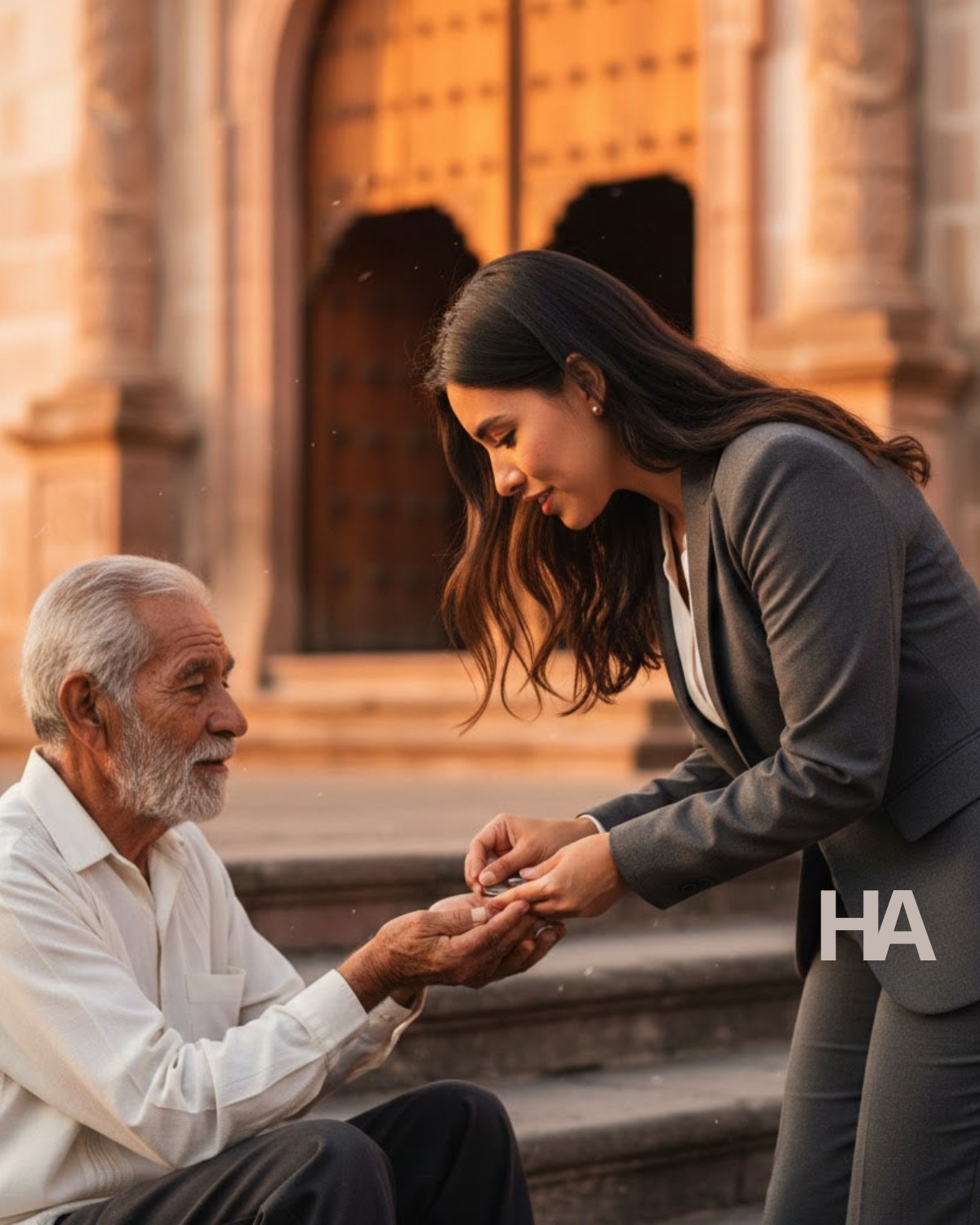
I dropped five dollars into his cup.
He looked up, surprised, then nodded once—just once—like he was accepting something sacred.
“Thank you,” he said quietly.
His voice was calm. Educated, almost. Not what my brain expected.
The next day, I did it again.
And the next.
Five dollars. Ten, if I had it. Sometimes I’d leave a granola bar. Sometimes a pair of gloves I’d bought without thinking.
I never asked his story. He never pushed it on me.
After a few weeks, I finally learned his name because the librarian came outside and called, “Walter, you need anything today?”
Walter.
It fit him. Plain. Old-fashioned. Solid.
Every morning, I’d nod. Every morning, I’d leave something. Every morning, he’d give me that same small, grateful look.
It became routine—my one predictable act of kindness inside a life that didn’t feel predictable anymore.
And then one evening, everything changed.
“Don’t Go Home Tonight.”
It was late—past dark—because I’d stayed overtime at work. The city building had emptied, the hallways quiet, the office lights buzzing like insects.
Outside, the streetlamps cast soft circles onto the sidewalk. The library was closed. Its tall windows reflected the night like black glass.
Walter was still there.
Same spot. Same coat. Same cardboard sign.
I walked toward him with my purse pulled close, already reaching for my wallet the way I always did. I squatted down, dropped a bill into his cup—
And Walter’s hand shot out and closed gently around mine.
Not a grab.
A hold.
Like he was stopping a child from stepping into traffic.
“Emily,” he said.
My body locked.
I had never told him my name.
I stared at him, my pulse instantly loud in my ears. “How… how do you know my name?”
Walter didn’t answer that. His eyes—usually tired, distant—were sharp now, focused in a way that made him look ten years younger.
“You’ve been too kind,” he said softly. “Too consistent.”
My throat went dry. “Walter, you’re scaring me.”
“I know.” His voice stayed calm, but his fingers tightened slightly around mine. “Listen to me. Don’t go home tonight. Stay in a hotel.”
I blinked, confused. “What?”
“Not your apartment,” he said, each word deliberate. “Not tonight. Promise me.”
My mind tried to file it under strange and unfortunate and keep walking, but something about his tone cut through the noise.
He wasn’t rambling.
He wasn’t begging.
He sounded… protective.
“Walter,” I whispered, “why? What’s going on?”
He leaned in just a little, like he didn’t want anyone passing by to hear.
“Because you’re being watched,” he said. “And tonight, someone’s going to go looking for something they think you have.”
A cold wave ran through me. “That’s insane.”
Walter’s gaze didn’t move. “It’s not.”
My heart kicked harder. “Who would watch me? I’m nobody.”
Walter’s face softened for a split second, and there was pain there—real pain—like my words had touched something personal.
“You were somebody to Michael,” he said.
My breath caught.
Michael’s name hadn’t been spoken outside my own mouth in months.
I couldn’t stop myself. “You knew my husband?”
Walter didn’t nod. Didn’t confirm. Not yet.
He just squeezed my hand again, like he was trying to transfer urgency into my skin.
“Please,” he said. “I’m not asking you to trust me forever. Just trust me tonight.”
Cars passed. A couple walked by laughing. The world kept moving like nothing was happening.
But my instincts—dormant under grief—woke up, snarling.
“Okay,” I heard myself say, even as my brain protested. “Okay. I’ll stay somewhere else.”
Walter’s shoulders released like he’d been holding his breath.
“Good,” he murmured. “Tomorrow morning. Come back here. Early. I’ll show you what I couldn’t tell you today.”
“What is it?” I asked, voice trembling. “What are you not telling me?”
Walter’s eyes flicked down the street once, quick and wary. Then back to me.
“The truth,” he said.
I stood up too fast, dizzy. “Walter—”
“Go,” he urged, gentle but firm. “Now.”
I walked away with my skin buzzing, my mind screaming questions.
And I told myself a dozen times: This is ridiculous. This is paranoid. This is a homeless man with nothing to lose scaring a widow for entertainment.
But I didn’t go home.
Because deep down, I believed him.
And I hated myself for how quickly I believed him.
The Message at 2:13 A.M.
The hotel I picked was cheap, near the bus station. The kind of place that smelled like old carpet and lemon cleaner. I paid in a hurry, hands shaking, and locked the door behind me like it could lock fear out too.
Sleep didn’t come.
I lay there listening to every sound—the elevator down the hall, a door closing, muffled voices—and every time, my brain whispered: They found you.
At 2:13 a.m., my phone buzzed so hard it nearly slid off the nightstand.
A message from my neighbor:
EMILY. YOUR DOOR IS BROKEN. POLICE ARE HERE. CALL ME.
My whole body went cold.
I called immediately. My neighbor answered in a whisper, like she was afraid the walls were listening.
“Emily,” she said, “someone broke in. They trashed your place. They were looking for something. The police— they keep asking where you are. Are you safe?”
I sat on the edge of the bed, shaking so badly my teeth clicked.
Walter’s voice replayed in my head:
Don’t go home tonight.
He’d known.
Hours before it happened.
I didn’t sleep at all after that.
I just watched the clock crawl forward, waiting for morning like it was an emergency exit.
Walter’s Past Was Not What I Expected
At dawn, I ran back to the library.
The air was sharp and clean, the kind of cold that makes your lungs feel too small. My hands were stuffed in my coat pockets. My head kept snapping around, checking every car, every person.
Walter was already there, sitting straighter than usual as if he’d been expecting me.
The moment he saw me, relief crossed his face so clearly it almost broke my heart.
“So,” he said quietly. “You listened.”
I stared at him, breath ragged. “My apartment was broken into.”
Walter closed his eyes for a brief second, like he’d been praying he’d be wrong.
“I’m sorry,” he said.
“How did you know?” I demanded. “Walter—how did you know?”
He looked at me with something that felt like guilt.
“Because I recognized the pattern,” he said. “And because… I’ve been watching them watch you.”
My stomach turned. “Who?”
Walter glanced around the street the way a person does when they’ve lived too long in danger—always aware of angles and reflections.
Then he said, “We need to talk somewhere warmer.”
I hesitated.
He read it immediately and gave a sad half-smile.
“You think I’m crazy,” he said.
“I think I’m terrified,” I corrected.
Walter nodded. “Fair.”
He stood up slowly, joints stiff, and to my surprise, he didn’t wobble. He moved with careful control—like a man who used to belong in places with rules and consequences.
We walked into a small coffee shop across the street. Walter chose a table in the corner where he could see the door, the windows, and the sidewalk outside.
That’s when I knew, for sure, that Walter wasn’t just “an old homeless man.”
He was someone who’d learned how to stay alive.
“Okay,” I said, forcing myself to hold eye contact. “Start talking.”
Walter’s hands wrapped around the paper cup like he needed the heat.
“I didn’t always live outside this library,” he began. “I didn’t always look like this.”
I waited, heart pounding.
He swallowed. “I worked with your husband.”
My chest tightened painfully. “Michael worked in compliance.”
Walter nodded once. “So did I.”
I stared at him, trying to fit the pieces together.
“My husband never mentioned you.”
Walter’s face flickered—something like regret, something like pride.
“He wouldn’t,” Walter said quietly. “That was the point.”
I leaned forward. “What are you talking about?”
Walter exhaled slowly, as if he’d been holding this story in his throat for years.
“Michael found something,” he said. “A fraud that wasn’t small. Not somebody skimming a little money. I mean… a machine. Built to move huge amounts through shell companies, offshore accounts, fake contracts. People in suits doing crimes with paperwork instead of guns.”
My skin went cold again. Michael had always been vague about his job. “I can’t tell you details,” he’d say. “It’s sensitive.”
I had assumed it was boring.
I had been wrong.
“He collected proof,” Walter continued. “And when he realized how big it was, he knew he couldn’t just report it internally. The people involved owned the ‘internal.’ They owned the system.”
My voice came out thin. “And what does that have to do with me?”
Walter’s eyes held mine, steady and heavy.
“Because when Michael realized the risk,” Walter said, “he tried to protect you.”
A lump formed in my throat. “Protect me from what?”
Walter hesitated.
Then he said, “From becoming leverage.”
My hands turned numb.
“Before Michael died,” Walter added, “he had something. Evidence. Enough to expose them. Enough to destroy careers and send people to prison.”
My breath hitched. “Are you saying… Michael didn’t just—”
Walter raised a hand immediately, calm. “I’m not saying that. I’m saying the timing of his death became… useful… to certain people.”
My stomach twisted.
Michael had died suddenly. A “random accident,” they’d said. A “terrible tragedy.”
And now I was sitting across from a man who knew my name and had predicted a break-in like he’d read tomorrow’s weather.
Walter reached inside his coat carefully, like he was handling a living thing.
He pulled out a small USB drive wrapped in an old cloth.
He placed it on the table between us.
“This,” he said, “is why they broke into your apartment. They think you have it.”
My eyes locked onto the drive. It looked harmless. Cheap plastic. A tiny object with the weight of a wrecking ball.
“I kept it,” Walter said. “Because Michael asked me to. He told me: If anything happens to me, protect Emily first.”
My throat burned. “Why would he trust you?”
Walter’s gaze dropped to his coffee for a moment.
“Because I tried to do the right thing,” he said. “And it cost me everything.”
I stared at him. “You became homeless because of this.”
Walter didn’t deny it.
He just said, “I became invisible. That was the safest place to be.”
My hands hovered over the USB drive like I was afraid to touch it.
“What do you want from me?” I whispered.
Walter’s voice softened. “I want you alive.”
Then, with a quiet intensity, he added:
“And I want your husband’s truth to matter.”
Claire Dawson
Walter didn’t want to plug the drive in at a random computer.
“Never,” he said. “Not public Wi-Fi. Not your work system. Not even a laptop you didn’t wipe yourself. These people track everything.”
Instead, he said we needed someone who knew how to handle evidence.
“A journalist,” he told me. “A real one. Not someone chasing clicks.”
Her name was Claire Dawson.
Independent investigative reporter. The kind who didn’t work for a big network because big networks had advertisers and shareholders and fear.
Walter had contacted her weeks ago, he said. He’d been waiting—watching—until he was sure the timing was right.
“Why now?” I asked.
Walter’s face hardened.
“Because last week, a man in a gray suit stood across the street and watched your building for twenty minutes,” he said. “Then yesterday, he followed you from the bus stop.”
My blood turned to ice.
Walter leaned closer. “Emily, they’re narrowing in. Last night wasn’t random. It was a test. A warning. They wanted to see if you’d panic. If you’d run. If you’d lead them to the evidence.”
My stomach flipped. “I don’t have it.”
Walter nodded. “They don’t know that. And they won’t stop until they’re sure.”
An hour later, Claire walked into the coffee shop like she belonged to the room.
Thirty-something. Sharp eyes. Dark coat. Messenger bag that looked like it carried more than notebooks. She scanned the place with a practiced glance and found us immediately.
She sat down without wasting time.
“I got your message,” she said to Walter. Then her gaze shifted to me. “You’re Emily.”
I stiffened. “Yes.”
Claire’s expression wasn’t pity. It wasn’t curiosity. It was focus.
“If this involves your husband,” she said, “I’m sorry. But I need you to understand something: if we open this box, you can’t close it again.”
Walter slid the USB drive toward her. “It’s real.”
Claire didn’t touch it yet. She studied it like it might bite.
“I’ll need to view it in a secure environment,” she said. “Air-gapped machine. No cloud. No network.”
Then she paused, eyes flicking toward the counter.
Walter’s body went still.
He didn’t look up, but his voice dropped to a whisper.
“Don’t turn around,” he said to me. “Man in a gray suit. At the register.”
My skin went cold.
Claire didn’t flinch. She simply stood as if she’d forgotten something.
“We’re leaving,” she said calmly. “Now.”
The Chase That Didn’t Look Like a Movie
See more on the next page
Advertisement
See more on the next page
Advertisement
