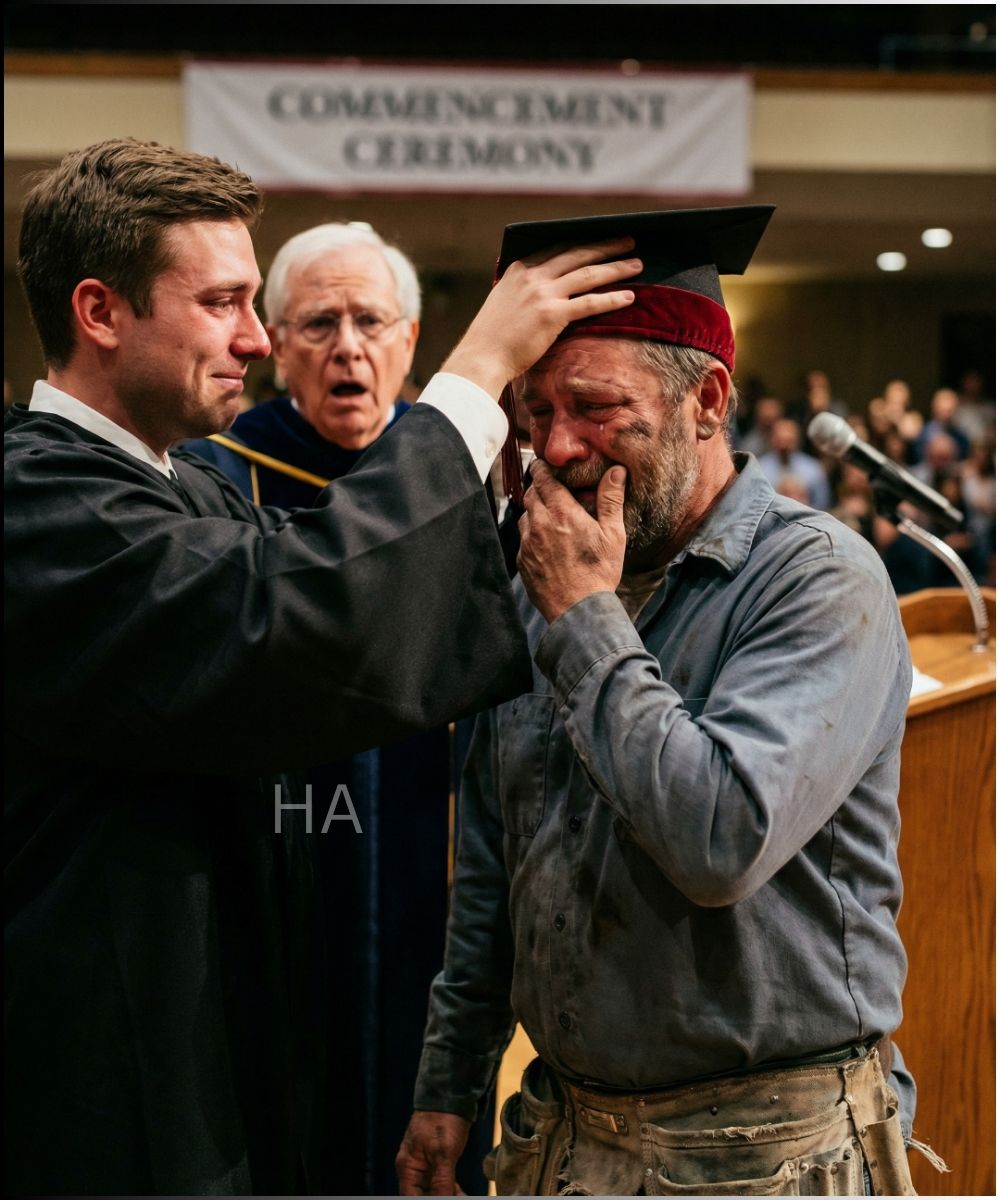
— “You are Hector Alvarez, aren’t you?”
The question hung in the air like a bell struck once and allowed to ring. Hector stiffened. I saw his shoulders tense beneath the borrowed jacket, his fingers curling slightly as if searching for a tool belt that wasn’t there.
“Yes,” he answered after a pause, his voice low. “That’s me.”
Professor Mendes let out a quiet breath, half laugh, half disbelief. He reached out and clasped Hector’s hand with both of his.
“I was hoping it was you,” Mendes said. “I wasn’t sure until I heard your name on the guest list.”
I stood frozen, diploma folder still warm in my hands, watching two men from entirely different worlds lock eyes like old companions who had once shared the same storm.
“You know each other?” I asked, my voice sounding smaller than I intended.
Hector glanced at me, then back at the professor. “A long time ago,” he said. “I worked for him. Or… with him. Depends how you look at it.”
Mendes chuckled softly. “With me,” he corrected. “Very much with me.”
The auditorium was slowly emptying, chairs scraping, families laughing, cameras flashing. Yet around us, time folded inward. Mendes gestured toward a quiet corner near the stage.
“May we sit?” he asked. “I think your son deserves to hear this story.”
Son.
The word landed between us. Hector did not correct him.
We sat. Mendes leaned back, his eyes drifting toward the high windows where afternoon light spilled in slanted beams.
“Twenty-five years ago,” he began, “before I ever stood in front of a lecture hall, I was an engineer on a failed public housing project in South Texas. The budget was slashed. Contractors vanished overnight. Most of the crew quit. Except one man.”
Hector shifted, uncomfortable.
“That man,” Mendes continued, “was named Hector Alvarez. He showed up every morning at dawn. No complaints. No drama. When materials didn’t arrive, he improvised. When the blueprints were wrong, he pointed it out. When I made mistakes,” Mendes smiled faintly, “he corrected me without ever making me feel small.”
I looked at Hector. He stared at his hands.
“There was a week,” Mendes said, “when funding stopped entirely. I was ready to walk away. Career over, reputation ruined. Hector stayed. He said, ‘If we leave it half-built, it will collapse and hurt someone. We finish it safe. Then we go.’”
Mendes swallowed.
“I asked him why. He said something I never forgot: ‘A job done halfway still leaves someone living under it.’”
Silence wrapped around us.
“That project,” Mendes went on, “was later reviewed and credited with preventing a structural failure that could have killed dozens. It didn’t save my job then. But years later, when I applied for a teaching post, someone remembered my name. Someone remembered that project.”
He turned to me.
“Your dissertation today,” Mendes said, “about ethical responsibility in infrastructure planning… it echoed that lesson. I could hear Hector’s voice in your arguments, even though you never mentioned him.”
I felt my throat tighten.
See more on the next page
Advertisement
