Part I — The Last Place They Expected Me to Stand
The laughter hit first—sharp, polished, and just cruel enough to pass for wit. Crystal glasses chimed against chandeliers that flung gold across the ballroom, and somewhere between the string quartet and the soft bite of champagne, I remembered to keep moving. People who don’t belong learn early that motion is camouflage.
I hovered near the flower arch with a tray of folded napkins because it gave my hands a job. The bride—my cousin—was buttercream-perfect beneath lace and light. My father, round at the middle and flush at the cheeks, was toasting with the family I had been taught to call mine, and my stepmother Victoria—glittering, silver, practiced—glided toward me.
“Sweetheart,” she cooed, voice dipped in honey and sharpened by a diamond. “Do yourself a favor. Don’t stand near the bride. We don’t want people thinking you’re part of the family photos.”
Her fingers brushed my shoulder; the tiny shove that followed wasn’t theatrical, but it had a destination. My heel caught on the edge of the rented carpet. A small constellation of guests tittered.
“She always finds a way to make things awkward.”
“Bless her heart. She tries.”
I smiled because I had been raised to treat dignity like a performance. The trick is to keep your body still while you fold the insult into an invisible pocket. I found my father across the room. He saw me. His mouth made a shape. He turned away.
There are nights when humiliation has temperature, and then there are nights when it has sound. This one had both—warmth under the skin, and that bright peal of laughter that says we are not cruel, we are clever. I took a breath, let it sit like a weight in my chest, and turned to face the crowd I had been trained to survive.
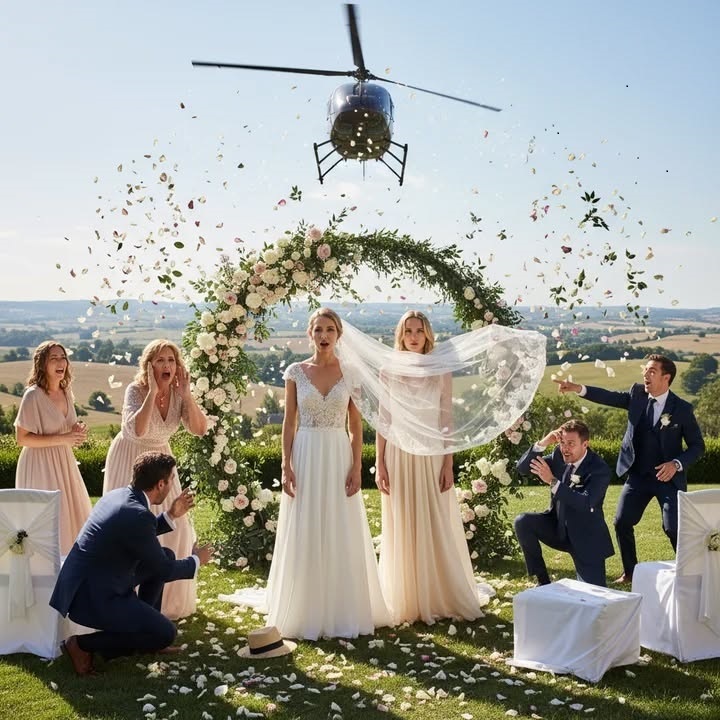
That was when the thump of rotors threaded itself into the music. It arrived first as an argument under the violin, then as certainty. Heads pivoted. A hush scratched along the marble when the glass doors opened and a wind came in, scattering petals like the last honest moment a room is willing to allow.
A man in a navy suit stepped through. He did not belong to the wedding. He belonged to precision. Broad shoulders; calm eyes; a presence calibrated precisely between unobtrusive and undeniable. He scanned the room once and walked straight toward me.
“Mrs. Grant,” he said, with a small bow. His voice was low and formal, the professional grace of a man used to doors opening. “The helicopter is ready. Mr. Grant sent me personally.”
The quartet bled to a stop. Champagne paused in midair. My stepmother’s smile broke like sugar in hot tea.
“You must be mistaken,” she snapped. “This is a private event.”
He didn’t look at her. His gaze stayed on me. “No mistake, ma’am.”
I felt my own pulse in my throat, strong as a fist knocking from the inside. For a breath, I did nothing. Then I set the napkins on the nearest table, smoothed the front of my borrowed dress, and stepped forward.
Victoria slid into my path, glittering blocked light. “What kind of joke is this, Claire?” she hissed.
“The kind that finally ends yours,” I said, soft enough that only the two of us could hear it, and stepped around her.
The man offered his hand. I took it. The crowd parted as if obeying choreography they hadn’t rehearsed. The night air hit my face—cool, electric, honest. I didn’t look back because I had spent years training my chin to stay lifted in rooms that tried to buckle it.
The rotor roar swallowed everything civilized. Flower petals swirled. Somewhere, a child squealed. Somewhere, my father said my name and found he didn’t know how to summon me anymore.
I climbed into the helicopter. The door shut with that soft, expensive click that sounds like a chapter closing. Through the window, the ballroom looked like a snow globe of other people’s certainty. I put on my headset. The man in navy adjusted his.
“Mr. Grant asked me to bring you to the tower,” he said. “He said you’d understand.”
I nodded. For years, I had watched the city from below like a story told about better people. Tonight, streets unwound beneath us in ribbons of gold, and I saw for the first time how obedient light can be when you rise above it.
My name is Claire. For a long time, I mistook silence for strength. I thought endurance would be mistaken for virtue if I wore it long enough. Life taught me otherwise; it rewards the ones who stand up. I learned when the world pushed me out of the house I was born into, and I built my own door.
Two years earlier, after the second wedding, Victoria told me—with that surgically kind voice—that “it wasn’t proper” for a grown daughter to live with a newlywed couple. My father slid bills across the table like an apology on rollers. I packed my life into a car with one working speaker and drove into a city that didn’t know my name.
I took two jobs. At noon, I wrangled chaos for a logistics firm that called itself “disruptive” and was mostly late. On weekends, I was an assistant at a quiet aerospace company that did not advertise anything. The owner, Nathan Grant, was late forties, sharp-eyed, surgically kind. He didn’t like excuses. He liked solutions. I liked working where competence made sense.
Late one night, he found me asleep on a stack of inventory forms, pencil still in my hand.
“You don’t have to prove anything to anyone,” he said, setting coffee near my elbow without asking permission. “Work speaks when people won’t.”
He meant it as an observation. My bones misheard it as a promise. Weeks became months. He saw what the world made a sport of ignoring. He gave me tasks that required a spine; then he asked my opinion out loud. He used the word mentor without making it sound like charity. When the company restructured, he promoted me. When his health began to shadow him, he called me into his office, closed the door, and told me the word successor like it was a keyword to a locked door.
The helicopter dipped. The Grant Aerodynamics Tower rose like glass holding its breath. The logo glowed—an arrow slicing air; the same emblem I had walked past in the rain on nights I was too proud for taxis.
We touched down. Cameras flashed far below—news had a way of finding altitude when it mattered. I smoothed my hair with the palm of my hand and stepped into the wind.
This wasn’t revenge. It was a recalibration. And it was about time.
Part II — The Room Where Respect Arrives Late
See more on the next page
Advertisement
See more on the next page
Advertisement
